A certification can help your resume pass an initial screening, but it cannot prove that you can build a working AI application. In 2026, the difference between a recognized industry credential and a certificate of course completion matters more than the number of badges on your LinkedIn profile.
If you are moving from Salesforce, QA, data engineering, testing, or technical support into AI, your goal should be to choose credentials that support the job you want—not collect every certificate available.
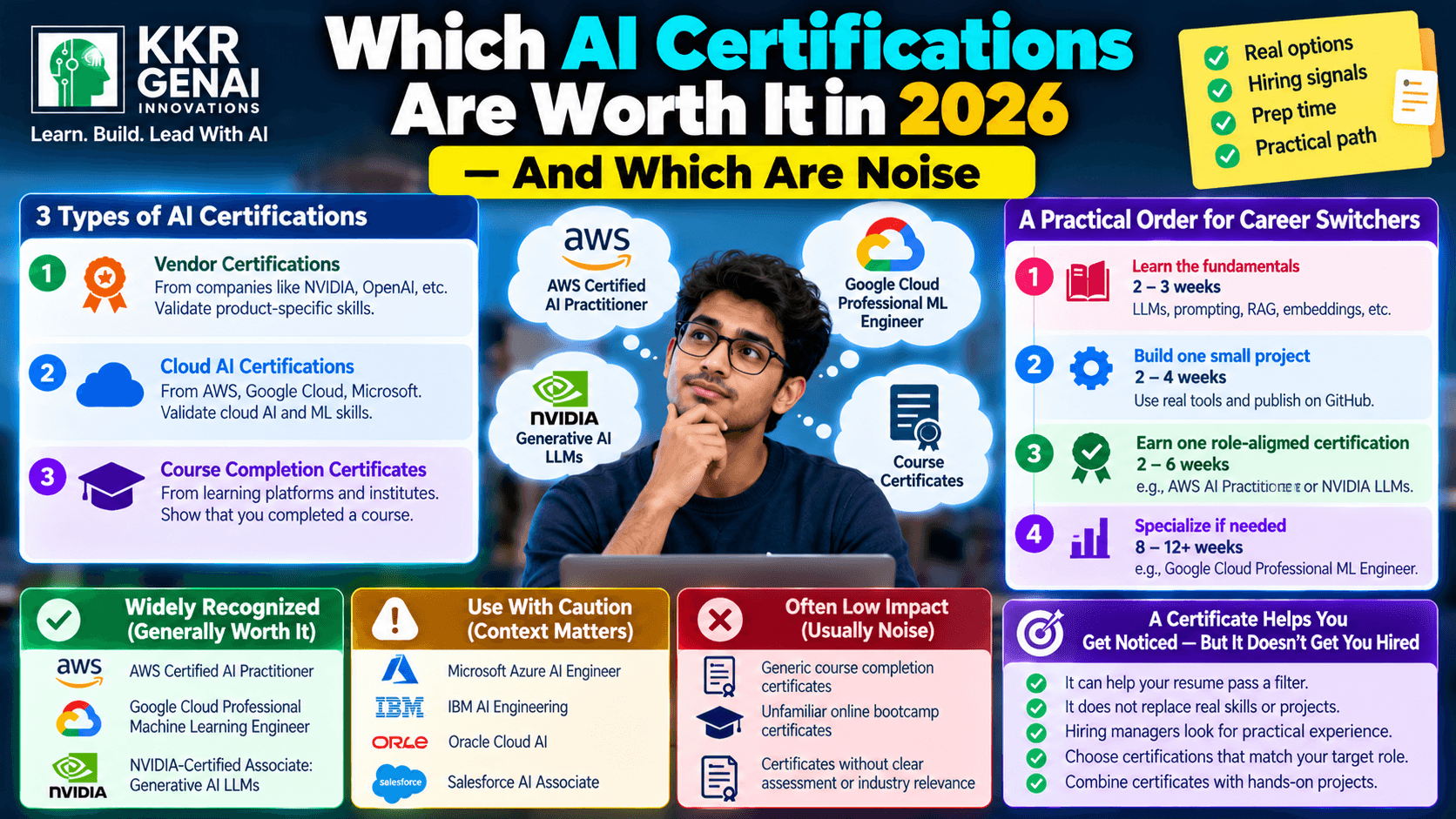
1. Three Types of AI Credentials
Vendor certifications come from companies that assess knowledge of their products or technologies. Examples include NVIDIA's Generative AI LLMs certification and certifications from major cloud providers. These credentials are most useful when the skills match the role you are targeting.
Cloud AI certifications validate knowledge of building or operating AI solutions on a specific cloud platform. Examples include AWS Certified AI Practitioner and Google Cloud Professional Machine Learning Engineer. The first is a foundational credential; the second targets experienced practitioners who build and operate machine learning systems.
Course completion certificates show that you completed a course or learning path. They can demonstrate initiative and structured learning, but they do not necessarily involve a proctored exam or independent assessment of your skills.
These categories serve different purposes. A course certificate can help you learn, a vendor certification can validate a defined set of skills, and a cloud certification can signal familiarity with a platform employers use.
2. Which Certifications Are Worth Considering in 2026?
AWS Certified AI Practitioner: A reasonable starting point if you work with AWS or want to understand AI concepts and services such as Amazon Bedrock. AWS lists the exam at $100, with a 90-minute duration and 65 questions. Plan approximately two to four weeks of preparation if you already understand basic cloud concepts. Official certification details.
NVIDIA-Certified Associate: Generative AI LLMs: Worth investigating if your goal involves integrating and maintaining generative AI applications. NVIDIA lists the associate exam at $125 with a one-hour duration. Allow roughly two to four weeks to study the objectives and practice the underlying concepts. Official NVIDIA certification details.
Google Cloud Professional Machine Learning Engineer: A stronger fit for people who already have programming, data, and cloud experience. Google recommends three or more years of industry experience, including at least one year designing and managing Google Cloud solutions. The exam costs $200 and lasts two hours, so a beginner should expect a longer preparation period—often eight to twelve weeks or more. Official certification details.
These credentials are not interchangeable. Choose AWS if your target roles use AWS, Google Cloud if you are pursuing its ML ecosystem, and NVIDIA if its generative AI technologies match the work you want to do.
3. What Hiring Managers Recognize—and What They May Ignore
Recognized vendor credentials can help recruiters and hiring managers quickly understand what you have studied. AWS, Google Cloud, and NVIDIA are established technology providers, and their certifications have defined objectives and assessment requirements. However, recognition varies by employer, job description, and team.
A certificate from an unfamiliar website may carry little weight if the hiring manager cannot determine what was assessed. A completion badge from a popular learning platform can still be useful, but it is usually evidence of learning rather than proof of job-ready engineering ability.
There is no universal list of certificates that every hiring manager recognizes. Read actual job postings for your target role, note which credentials appear repeatedly, and ask people working in that field which qualifications influence screening decisions.
Most importantly, connect the credential to evidence of practical work. A GitHub project that uses Python, an LLM API, PostgreSQL with pgvector, and a tested RAG pipeline can give an interviewer something concrete to evaluate. A certificate alone cannot demonstrate that you can debug retrieval failures, control token costs, or handle API errors.
4. A Practical Certification Order for Career Switchers
Step 1 — Learn the fundamentals (two to three weeks). Study LLMs, tokens, embeddings, prompting, RAG, model evaluation, and responsible AI. Use a reputable course or official learning path; do not pay for an exam before you understand the basics.
Step 2 — Build one small project (two to four weeks). Create a document-question-answering application using Python, an LLM API, and a searchable knowledge base. Add logging, error handling, and a small evaluation set. This work helps turn theory into practical skills.
Step 3 — Earn one role-aligned certification (two to six weeks). If you are already comfortable with cloud basics, consider AWS Certified AI Practitioner. If you want a more technical generative AI credential, investigate NVIDIA's associate certification. Preparation time depends on your existing experience and weekly study hours.
Step 4 — Specialize when your target role requires it (eight to twelve weeks or more). Consider a professional-level cloud ML credential only when you have the programming, data, and platform background to benefit from it. Do not pursue an advanced exam simply because its title sounds more impressive.
These preparation ranges are planning estimates, not guarantees. Check each official exam guide before booking, because objectives, exam formats, prices, and availability can change.
5. The Certificate Is a Signal, Not the Finish Line
Use certifications to strengthen a career plan, not replace one. Choose a target role, inspect ten to fifteen relevant job postings, identify the skills and credentials that recur, and prioritize the gaps you can realistically close.
For each certificate, aim to produce a matching project or demonstration. If you study cloud AI, deploy a small application; if you study generative AI, build and evaluate a RAG assistant; if you study model operations, document monitoring, failure handling, and cost controls.
One relevant certification and two well-documented projects can tell a stronger story than ten unrelated course badges. Your aim is to make it easy for an employer to see what you know, what you have built, and how those skills fit the role.
Which certification are you taking first — and by what date? Give me an actual date.
Join the KKRGENAI community discussion to share your certification plan, compare preparation strategies, and learn from other AI career switchers.