What Actually Happens Inside a Context Window
An AI model can support a context window of 128,000 tokens and still miss an important instruction buried in a long conversation. A bigger context window gives the model more room, but it does not guarantee that every detail will be used correctly.
If you are building chatbots, AI agents, or document-search applications, understanding the context window helps you control accuracy, cost, and response quality.
1. What Is a Context Window, Really?
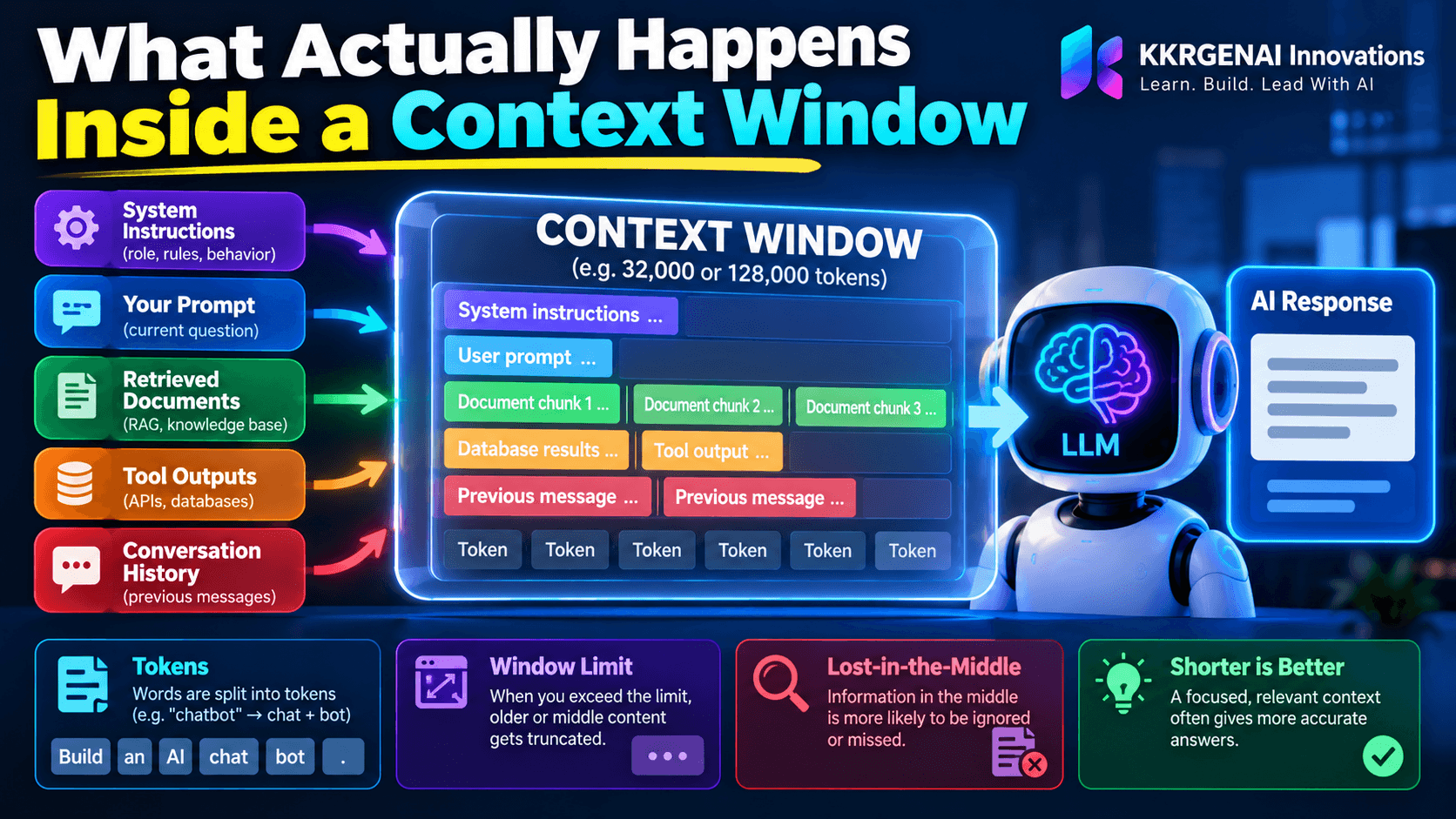
A context window is the amount of information a model can process for a particular request. Depending on the model and interface, this can include system instructions, your prompt, conversation history, retrieved documents, tool outputs, and space reserved for the response.
This information is measured in tokens, not simply words or characters. A token can represent a whole word, part of a word, punctuation, or a combination of characters.
For example, consider this sentence: “Build an AI chatbot using Python.” A simplified token breakdown might look like this:
Build | an | AI | chatbot | using | Python | .This illustrates the idea, not the exact tokenization used by a particular model. A real tokenizer might split “chatbot” or other words into smaller pieces, and different models can tokenize the same sentence differently.
You can inspect actual tokenization with OpenAI's Tokenizer tool or the Python tiktoken library for supported OpenAI models. For planning, remember that 1,000 tokens may represent roughly 600–800 English words, but code, tables, and unusual text can change that ratio.
2. What Happens When You Reach the Limit?
Imagine an application using a model with a 32,000-token context window. If the system instructions, conversation history, retrieved documents, current question, and requested response collectively exceed the available budget, the application must reduce the input, shorten the output budget, or use a different model or strategy.
Some interfaces truncate older messages. Others summarize history, remove less relevant documents, or reject the request. There is no universal rule that every model automatically deletes the oldest text, so developers need to understand how their particular API or framework manages context.
There is another problem: the “lost-in-the-middle” effect. Research has found that language models can perform better when relevant information appears near the beginning or end of a long input than when the same information is buried in the middle.
That does not mean models always ignore the middle. Performance depends on the model, task, and input structure, but the practical lesson is important: including information in the context does not guarantee that the model will use it effectively.
3. Why a Longer Prompt Can Produce a Worse Answer
Consider a support chatbot answering this question: “How do I reset my password?” Its context contains 20 pages of product documentation, old conversations, unrelated troubleshooting steps, and a lengthy set of general instructions.
The correct password-reset procedure is present, but it competes with thousands of irrelevant tokens. The model may retrieve the wrong procedure, overlook a condition, or generate a confusing response.
Before: Too much context
Here are 15 product manuals, 50 old
support messages, general company history,
billing policies, troubleshooting notes,
and several outdated password procedures.

Answer the user's question accurately.
After: Focused context
Task: Explain how to reset a password.

Current verified procedure:
1. Open the sign-in page.
2. Select "Forgot password?"
3. Follow the emailed reset link.

Constraint: Do not invent steps.
If the procedure does not apply, ask
a clarifying question.

User question: How do I reset my password?
The second example reduces noise and makes the relevant facts easier to identify. It is not guaranteed to succeed every time, but it gives the model a clearer task and more useful evidence.
4. How to Manage Context in Real AI Applications
Start by separating instructions from reference material. Put high-priority behavioral rules in the appropriate system or developer instruction fields supported by your model API, and keep the user's current request clearly identified.
Place relevant retrieved documents close to the question they support, using clear labels and source information. For retrieval-augmented generation (RAG), tools such as LangChain, LlamaIndex, PostgreSQL with pgvector, and vector databases can help retrieve relevant content instead of sending an entire knowledge base to the model.
Next, set a context budget. For example, in a hypothetical 32,000-token budget, you might reserve 2,000 tokens for instructions and the current question, 18,000 for retrieved information and conversation history, and 4,000 for the maximum response, leaving 8,000 tokens of flexibility.
Those figures are an example, not a universal configuration. The usable budget depends on the model's limits, API behavior, output requirements, and application design. Measure actual token counts rather than relying only on word counts.
When context grows too large, cut unrelated documents first, remove duplicate information, summarize older conversation history, and retrieve fewer but more relevant passages. Preserve essential safety rules, permissions, current facts, and constraints; never remove important information simply because it is old.
5. Turn Context Management Into an Engineering Skill
If you come from data engineering, your experience with pipelines, SQL, and data quality can help you build reliable retrieval systems. QA professionals can test whether the right facts are retrieved and whether answers change when relevant information moves within a long context.
Salesforce developers can connect approved CRM records to AI assistants, while support professionals can help organize troubleshooting knowledge and identify which details a chatbot needs to answer common questions. Each background provides a useful starting point.
Build a small experiment with 20–30 questions, a set of source documents, and a model you can access. Compare a long-context approach with a focused retrieval approach, then measure answer accuracy, token usage, latency, and cost.
A context window is not just a technical limit to memorize. It is a resource you must manage so that the model receives the right information, in a useful structure, at the right time.
Have you ever had a long prompt quietly ignored? What did you do about it?
Join the KKRGENAI Innovations community discussion to share your experience, compare experiments, and learn how other developers are building more reliable AI applications.