Prompt Engineering vs Context Engineering: The Difference Nobody Explains Properly
You can write a perfect prompt and still get a completely wrong answer from an AI model. The problem may not be what you asked—it may be the information the model never received.
That is the difference between prompt engineering and context engineering. If you are moving from Salesforce, data engineering, QA, or technical support into AI, understanding this distinction can change what you build and which skills you learn next.
1. A Prompt Is Not the Whole Input
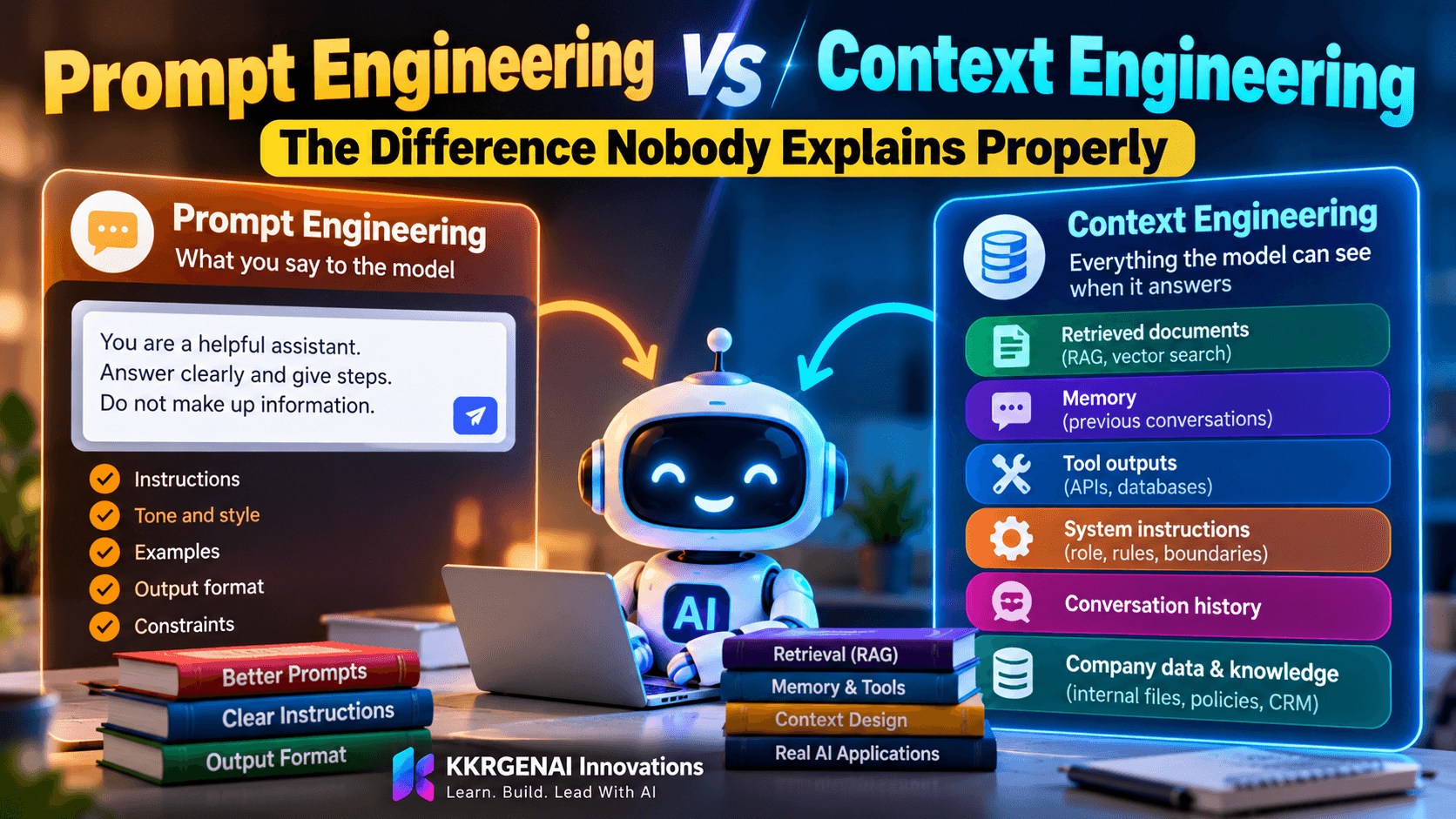
Prompt engineering focuses on how you instruct a model. You define the task, explain the expected format, provide examples, and set constraints so the model produces a more useful answer.
For example, instead of asking, “Explain this error,” you might write: “Explain this Python error in plain English, identify the likely cause, and give three debugging steps. Do not invent missing information.” That is a better prompt because it gives the model clearer instructions.
Context engineering covers the broader information available when the model generates its response. This can include system instructions, the user's message, conversation history, retrieved documents, database results, memory, and outputs from tools.
Think of the prompt as the task you assign. Context is the collection of instructions, facts, and supporting information the model can use to complete it. A strong prompt cannot compensate for missing or outdated information.
2. Where the Real Engineering Work Happens
In a real AI application, someone must decide what information reaches the model, where that information comes from, and whether it is relevant and trustworthy. That work often matters more than repeatedly rewriting the same prompt.
Consider a company chatbot that answers questions about its training courses. The system may need to retrieve current course fees from PostgreSQL, find the correct policy document using a vector database, remember the user's earlier question, and follow instructions about what it must never promise.
These are separate engineering responsibilities:
- Retrieval: Search relevant documents using tools such as pgvector, Pinecone, or Elasticsearch.
- Memory: Store useful conversation details and retrieve them when appropriate.
- Tool outputs: Pass verified results from APIs, databases, or application functions into the model.
- System instructions: Define the assistant's role, boundaries, and response rules.
- Conversation history: Include enough previous messages to maintain continuity without overwhelming the model.
Engineers must also manage context-window limits, permissions, conflicting information, latency, and cost. More context is not automatically better: irrelevant documents can distract the model, while poorly controlled retrieval can expose information the user should not see.
3. The Same Task: Bad Prompting vs Good Context
Imagine a student asks a training institute's chatbot: “Can I access recorded classes after the course ends?” The actual policy says recorded sessions are available for a defined access period, but the chatbot has not been given that policy.
Approach A: Keep improving the prompt
You are a helpful course assistant.
Answer clearly and confidently.
Tell students how long recordings remain available.
Never give a vague answer.
The instruction sounds reasonable, but the model still lacks the actual access period. It might guess that recordings remain available forever or invent a specific number of months. A confident answer is not necessarily a correct answer.
Approach B: Build the right context
System instruction:
Answer only from verified course policies.
If the policy is missing, say you need confirmation.

Retrieved policy:
Recording access period: 12 months.
Source: Current course access policy.

User question:
Can I access recorded classes after the course ends?
Now the model has the relevant fact and a rule for handling missing information. It can explain that access lasts 12 months, assuming the retrieved policy is current and applies to that student's course.
The second approach requires more than writing instructions. It needs a reliable data source, retrieval logic, source selection, access controls, and tests for incorrect answers. That is context engineering in practice.
4. Why the Language in AI Job Descriptions Is Changing
Prompt engineering became widely discussed as people discovered that better instructions could improve model responses. But production applications need more than clever wording: they need reliable data, tool integration, repeatable workflows, evaluation, and monitoring.
That is why context engineering is gaining attention in AI engineering discussions and some job descriptions. Teams building retrieval-augmented generation (RAG), AI agents, and enterprise assistants must design the information flow around the model, not just the text sent to it.
However, be careful with job-title claims. Prompt Engineer is a real title at some employers, and prompt design remains a useful skill. Context Engineer is an emerging term, not yet a standardized occupation with a consistent definition across the industry.
Many of these responsibilities already exist under titles such as AI Engineer, LLM Engineer, Applied AI Engineer, and Machine Learning Engineer. Read the responsibilities in a job posting rather than assuming a new title represents an entirely new profession.
5. What Should You Learn Next?
If you come from Salesforce, learn how to connect CRM records and approved business data to an AI assistant through secure APIs. If you work in data engineering, focus on document pipelines, embeddings, vector search, metadata filtering, and retrieval quality.
QA professionals can contribute by testing hallucinations, evaluating retrieval accuracy, checking permissions, and building repeatable AI evaluation suites. Support professionals can use their knowledge of troubleshooting workflows to design useful knowledge retrieval and escalation systems.
Start with Python, REST APIs, SQL, and prompt fundamentals. Then build a small RAG application using PostgreSQL with pgvector, add source citations, test it against 30–50 realistic questions, and measure whether it retrieves the right information and answers accurately.
You do not need to abandon prompt engineering. You need to understand where it fits inside a complete AI system. Good instructions help a model use its input; good context engineering helps ensure that input contains the right information in the first place.
Which of the two do you think is actually the job — and which one are you spending your practice time on?
Join the KKRGENAI Innovations community discussion to share your experience, compare approaches, and learn how other IT professionals are building practical Generative AI skills.