From Zero to ChatGPT
Thanks to Large Language Models (or LLMs for short), Artificial Intelligence has now caught the attention of pretty much everyone. ChatGPT, possibly the most famous LLM, has immediately skyrocketed in popularity due to the fact that natural language is such a, well, natural interface that has made the recent breakthroughs in Artificial Intelligence accessible to everyone. Nevertheless, how LLMs work is still less commonly understood, unless you are a Data Scientist or in another AI-related role. In this article, I will try to change that.
Admittedly, that’s an ambitious goal. After all, the powerful LLMs we have today are a culmination of decades of research in AI. Unfortunately, most articles covering them are one of two kinds: They are either very technical and assume a lot of prior knowledge, or they are so trivial that you don’t end up knowing more than before.
This article is meant to strike a balance between these two approaches.
Or actually let me rephrase that, it’s meant to take you from zero
all the way through to how LLMs are trained and why they work so
impressively well. We’ll do this by picking up just all the relevant
pieces along the way.
This is not going to be a deep dive into all the nitty-gritty details,
so we’ll rely on intuition here rather than on math, and on visuals
as much as possible. But as you’ll see, while certainly being a very
complex topic in the details, the main mechanisms underlying LLMs are
very intuitive, and that alone will get us very far here.
This article should also help you get more out of using LLMs like
ChatGPT. In fact, we will learn some of the neat tricks that you can
apply to increase the chances of a useful response. Or as Andrei
Karparthy, a well-known AI researcher and engineer, recently and
pointedly said: “English is the hottest new programming language.”
But first, let’s try to understand where LLMs fit in the world of
Artificial Intelligence.
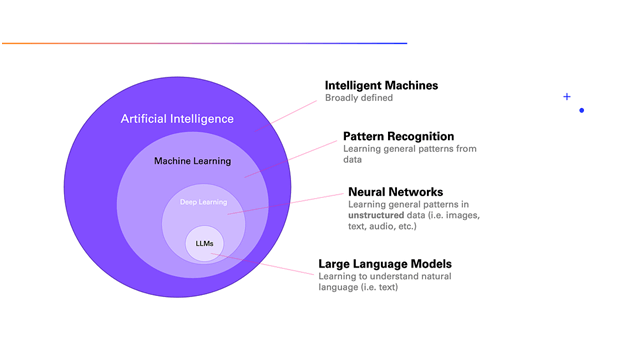 The field of Artificial Intelligence in layers.
The Field of Artificial Intelligence in Layers
AI can be visualized in layers, each focusing on different aspects of intelligent behavior:
- Artificial Intelligence (AI): A broad field focused on creating intelligent machines.
- Machine Learning (ML): A subfield of AI that recognizes patterns in data.
- Deep Learning: A branch of ML dealing with unstructured data such as text and images.
- Large Language Models (LLMs): Specialize in processing text and generating natural language responses.
As we go, we’ll pick up the relevant pieces from each of those layers. We’ll skip only the most outer one, Artificial Intelligence (as it is too general anyway) and head straight into what is Machine Learning.
The goal of Machine Learning is to discover patterns in data. Or more
specifically, a pattern that describes the relationship between an
input and an outcome. This is best explained using an example.
Let’s say we would like to distinguish between two of my favorite
genres of music: reggaeton and R&B. If you are not familiar with
those genres, here’s a very quick intro that will help us understand
the task. Reggaeton is a Latin urban genre known for its lively beats
and danceable rhythms, while R&B (Rhythm and Blues) is a genre
rooted in African-American musical traditions, characterized by
soulful vocals and a mix of upbeat and slower-paced songs.
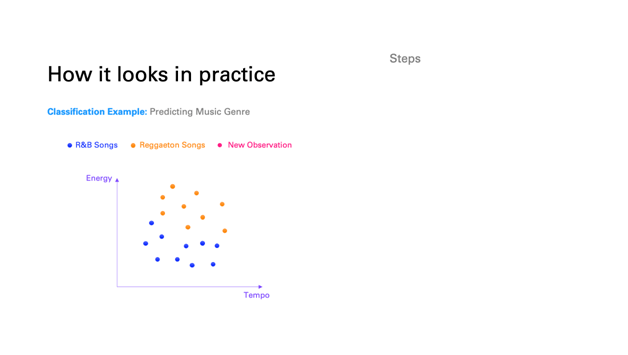 Machine Learning in practice. Predicting music genre is an example
of a classification problem.
Suppose we have 20 songs. We know each song’s tempo and energy, two
metrics that can be simply measured or computed for any song. In
addition, we’ve labeled them with a genre, either reggaeton or R&B.
When we visualize the data, we can see that high energy, high tempo
songs are primarily reggaeton while lower tempo, lower energy songs
are mostly R&B, which makes sense.
However, we want to avoid having to label the genre by hand all the
time because it’s time consuming and not scalable. Instead, we can
learn the relationship between the song metrics (tempo, energy) and
genre and then make predictions using only the readily available
metrics.
In Machine Learning terms, we say that this is a classification
problem, because the outcome variable (the genre) can only take on
one of a fixed set of classes/labels — here reggaeton and R&B.
This is in contrast to a regression problem, where the outcome is a
continuous value (e.g., a temperature or a distance).
We can now “train” a Machine Learning model (or “classifier”) using
our labeled dataset, i.e., using a set of songs for which we do know
the genre. Visually speaking, what the training of the model does
here is that it finds the line that best separates the two classes.
How is that useful? Well, now that we know this line, for any new song
we can make a prediction about whether it’s a reggaeton or an R&B
song, depending on which side of the line the song falls on. All we
need is the tempo and energy, which we assumed is more easily available.
That is much simpler and scalable than have a human assign the genre
for each and every song.
Additionally, as you can imagine, the further away from the line,
the more certain we can be about being correct. Therefore, we can
often also make a statement on how confident we are that a prediction
is correct based on the distance from the line. For example, for our
new low-energy, low-tempo song we might be 98 percent certain that
this is an R&B song, with a two percent likelihood that it’s
actually reggaeton.
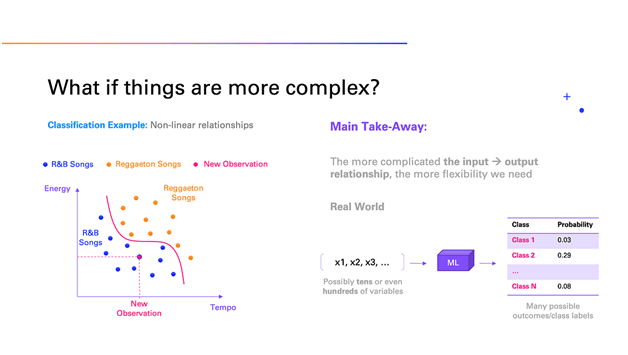 In reality, things are often much more complex.
But of course, reality is often more complex than that.
The best boundary to separate the classes may not be linear. In other
words, the relationship between the inputs and the outcome can be
more complex. It may be curved as in the image above, or even many
times more complex than that.
Reality is typically more complex in another way too. Rather than
only two inputs as in our example, we often have tens, hundreds, or
even thousands of input variables. In addition, we often have more
than two classes. And all classes can depend on all these inputs
through an incredibly complex, non-linear relationship.
Even with our example, we know that in reality there are more than
two genres, and we need many more metrics other than tempo and energy.
The relationship among them is probably not so simple either.
What I mainly want you to take away is this: The more complex the
relationship between input and output, the more complex and powerful
is the Machine Learning model we need in order to learn that
relationship. Usually, the complexity increases with the number of
inputs and the number of classes.
In addition to that, we also need more data as well. You will see why
this is important in just a bit.
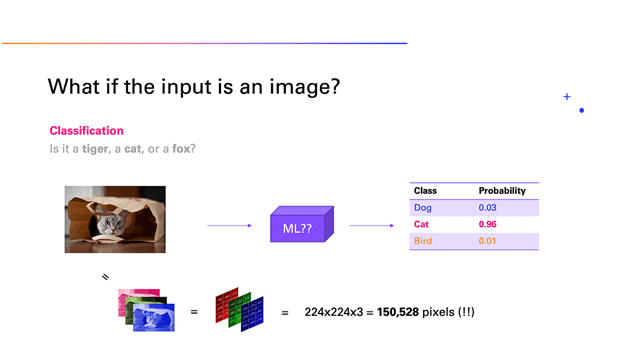 Image classification example.
Let’s move on to a slightly different problem now, but one for which
we will simply try to apply our mental model from before. In our new
problem we have as input an image, for example, this image of a cute
cat in a bag (because examples with cats are always the best).
As for our outcome, let’s say this time that we have three possible
labels: tiger, cat, and fox. If you need some motivation for this
task, let’s say we may want to protect a herd of sheep and sound an
alarm if we see a tiger but not if we see a cat or a fox.
We already know this is again a classification task because the output
can only take on one of a few fixed classes. Therefore, just like
before, we could simply use some available labeled data (i.e., images
with assigned class labels) and train a Machine Learning model.
However, it’s not quite obvious as to exactly how we would process a
visual input, as a computer can process only numeric inputs. Our song
metrics energy and tempo were numeric, of course. And fortunately,
images are just numeric inputs too as they consist of pixels. They
have a height, a width, and three channels (red, green, and blue).
So in theory, we could directly feed the pixels into a Machine
Learning model.
However, now we are facing two problems. First, even a small,
low-quality 224x224 image consists of more than 150,000 pixels
(224x224x3). Remember, we were speaking about a maximum of hundreds
of input variables, but now we suddenly have at least 150,000.
Second, if you think about the relationship between the raw pixels
and the class label, it’s incredibly complex, at least from an ML
perspective that is. Our human brains have the amazing ability to
generally distinguish among tigers, foxes, and cats quite easily.
However, if you saw the 150,000 pixels one by one, you would have no
idea what the image contains. But this is exactly how a Machine
Learning model sees them, so it needs to learn from scratch the
mapping or relationship between those raw pixels and the image label,
which is not a trivial task.
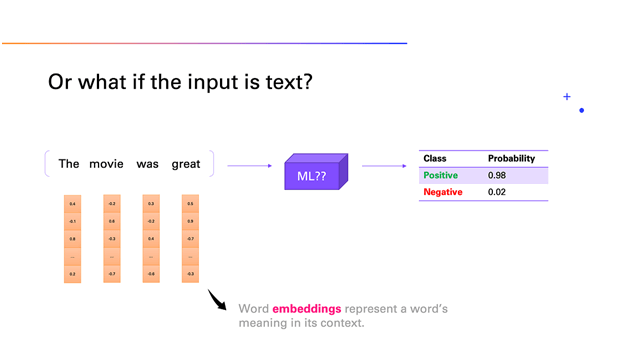 Sentiment classification example.
 Large Language Models. Level: Expert.
Finally, we can start talking about Large Language Models, and this
is where things get really interesting. If you have made it this far,
you should have all the knowledge to also understand LLMs.
What’s a good way to start? Probably by explaining what Large Language
Model actually means. We already know what large means, in this case
it simply refers to the number of neurons, also called parameters,
in the neural network. There is no clear number for what constitutes
a Large Language Model, but you may want to consider everything above
1 billion neurons as large.
With that established, what’s a “language model”? Let’s discuss this
next — and just know that in a bit, we’ll also get to learn what the
GPT in ChatGPT stands for. But one step at a time.
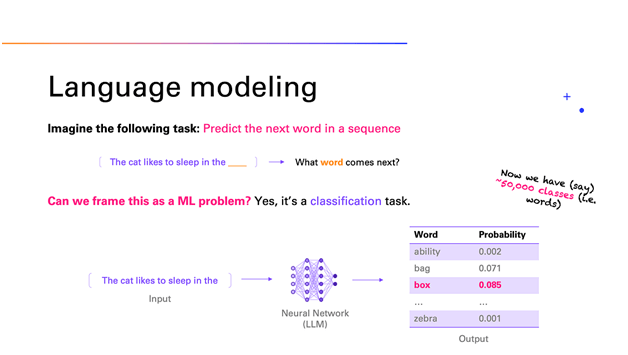 Language modeling is learning to predict the next word.
Let’s take the following idea and frame it as a Machine Learning
problem: What is the next word in a given sequence of words, i.e.,
in a sentence or paragraph? In other words, we simply want to learn
how to predict the next word at any time.
From earlier in this article we’ve learned everything we need to frame
that as a Machine Learning problem. In fact, the task is not unlike
the sentiment classification we saw earlier.
As in that example, the input to the neural network is a sequence of
words, but now, the outcome is simply the next word. Again, this is
just a classification task. The only difference is that instead of
only two or a few classes, we now have as many classes as there are
words — let’s say around 50,000.
This is what language modeling is about — learning to predict the
next word.
Okay, so that’s orders of magnitude more complex than the binary
sentiment classification, as you can imagine. But now that we also
know about neural networks and their sheer power, the only response
to that concern is really “why not?”
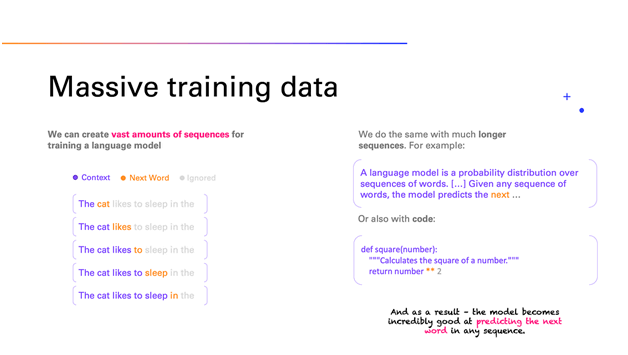 Massive amounts of training data can be created relatively easily.
We know the task, and now we need data to train the neural network.
It’s actually not difficult to create a lot of data for our “next
word prediction” task. There’s an abundance of text on the internet,
in books, in research papers, and more. And we can easily create a
massive dataset from all of this.
We don’t even need to label the data, because the next word itself
is the label, that’s why this is also called self-supervised learning.
The image above shows how this is done. Just a single sequence can be
turned into multiple sequences for training. And we have lots of such
sequences. Importantly, we do this for many short and long sequences
(some up to thousands of words) so that in every context we learn
what the next word should be.
To summarize, all we are doing here is to train a neural network
(the LLM) to predict the next word in a given sequence of words,
no matter if that sequence is long or short, in German or in English
or in any other language, whether it’s a tweet or a mathematical
formula, a poem or a snippet of code. All of those are sequences
that we will find in the training data.
If we have a large enough neural network as well as enough data,
the LLM becomes really good at predicting the next word. Will it
be perfect? No, of course not, since there are often multiple words
that can follow a sequence. But it will become good at selecting one
of the appropriate words that are syntactically and semantically
appropriate.
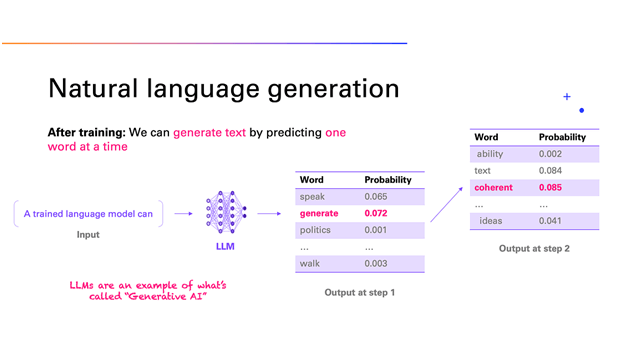 We can perform natural language generation by predicting one
word at a time.
Now that we can predict one word, we can feed the extended sequence
back into the LLM and predict another word, and so on. In other words,
using our trained LLM, we can now generate text, not just a single
word. This is why LLMs are an example of what we call Generative AI.
We have just taught the LLM to speak, so to say, one word at a time.
There’s one more detail to this that I think is important to understand.
We don’t necessarily always have to predict the most likely word.
We can instead sample from, say, the five most likely words at a given
time. As a result, we may get some more creativity from the LLM.
Some LLMs actually allow you to choose how deterministic or creative
you want the output to be. This is also why in ChatGPT, which uses
such a sampling strategy, you typically do not get the same answer
when you regenerate a response.
Speaking of ChatGPT, you could ask yourself now why it’s not called
ChatLLM. As it turns out, language modeling is not the end of the story
— in fact it’s just the beginning. So what does the GPT in ChatGPT
stand for?
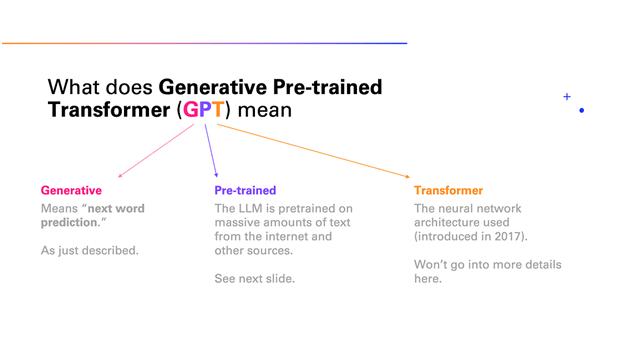 GPT = Generative Pre-trained Transformer.
We have actually just learned what the G stands for, namely
“generative” — meaning that it was trained on a language generation
pretext, which we have discussed.
But what about the P and the T? We’ll gloss over the T here, which
stands for “transformer” — not the one from the movies (sorry), but
one that’s simply the type of neural network architecture that is
being used.
This shouldn’t really bother us here, but if you are curious and you
only want to know its main strength, it’s that the transformer
architecture works so well because it can focus its attention on the
parts of the input sequence that are most relevant at any time.
You could argue that this is similar to how humans work. We, too,
need to focus our attention on what’s most relevant to the task and
ignore the rest.
Now to the P, which stands for “pre-training”. We discuss next why
we suddenly start speaking about pre-training and not just training
any longer.
The reason is that Large Language Models like ChatGPT are actually
trained in phases.
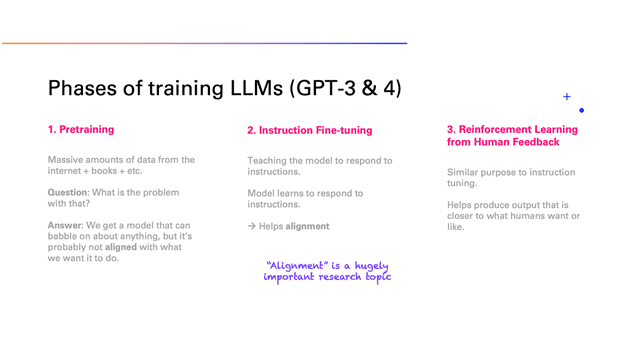 Phases of LLM training: (1) Pre-Training,
(2) Instruction Fine-Tuning,
(3) Reinforcement from Human Feedback (RLHF).
Pre-training
The first stage is pre-training, which is exactly what we’ve gone
through just now. This stage requires massive amounts of data to learn
to predict the next word. In that phase, the model learns not only
to master the grammar and syntax of language, but it also acquires
a great deal of knowledge about the world, and even some other
emerging abilities that we will speak about later.
But now I have a couple of questions for you: First, what might be
the problem with this kind of pre-training? Well, there are certainly
a few, but the one I am trying to point to here has to do with what
the LLM has really learned.
Namely, it has learned mainly to ramble on about a topic. It may even
be doing an incredibly good job, but what it doesn’t do is respond
well to the kind of inputs you would generally want to give an AI,
such as a question or an instruction.
The problem is that this model has not learned to be, and so is not
behaving as, an assistant.
For example, if you ask a pre-trained LLM “What is your fist name?”
it may respond with “What is your last name?” simply because this is
the kind of data it has seen during pre-training, as in many empty
forms, for example. It’s only trying to complete the input sequence.
It doesn’t do well with following instructions simply because this
kind of language structure, i.e., instruction followed by a response,
is not very commonly seen in the training data.
At this stage, we say that the LLM is not aligned with human
intentions. Alignment is an important topic for LLMs, and we’ll
learn how we can fix this to a large extent, because as it turns out,
those pre-trained LLMs are actually quite steerable.
So even though initially they don’t respond well to instructions,
they can be taught to do so.
Instruction fine-tuning and RLHF
This is where instruction tuning comes in. We take the pre-trained
LLM with its current abilities and do essentially what we did before
— i.e., learn to predict one word at a time — but now we do this using
only high-quality instruction and response pairs as our training data.
That way, the model un-learns to simply be a text completer and learns
to become a helpful assistant that follows instructions and responds
in a way that is aligned with the user’s intention.
The size of this instruction dataset is typically a lot smaller than
the pre-training set. This is because the high-quality
instruction-response pairs are much more expensive to create as they
are typically sourced from humans.
This is very different from the inexpensive self-supervised labels
we used in pre-training. This is why this stage is also called
supervised instruction fine-tuning.
There is also a third stage that some LLMs like ChatGPT go through,
which is reinforcement learning from human feedback (RLHF).
We won’t go into details here, but the purpose is similar to
instruction fine-tuning.
RLHF also helps alignment and ensures that the LLM’s output reflects
human values and preferences. There is some early research that
indicates that this stage is critical for reaching or surpassing
human-level performance.
In fact, combining the fields of reinforcement learning and language
modeling is being shown to be especially promising and is likely to
lead to some massive improvements over the LLMs we currently have.
So now let’s test our understanding on some common use cases.
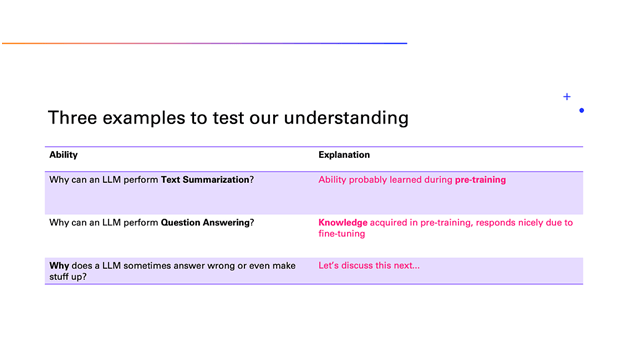 Examples to test our understanding of LLMs.
First, why can an LLM perform summarization of a longer piece of text?
(If you didn’t already know, it does a really great job. Just paste
in a document and ask it to summarize it.)
To understand why, we need to think about the training data. As it so
happens, people often make summarizations — on the internet, in
research papers, books, and more.
As a result, an LLM trained on that data learns how to do that too.
It learns to attend to the main points and compress them into a short
text.
Note that when a summary is generated, the full text is part of the
input sequence of the LLM. This is similar to, say, a research paper
that has a conclusion while the full text appears just before.
As a result, that skill has probably been learned during pre-training
already, although surely instruction fine-tuning helped improve that
skill even further. We can assume that this phase included some
summarization examples too.
Second, why can a LLM answer common knowledge questions?
As mentioned, the ability to act as an assistant and respond
appropriately is due to instruction fine-tuning and RLHF. But all
(or most of) the knowledge to answer questions itself was already
acquired during pre-training.
Of course, that now raises another big question: What if the LLM
doesn’t know the answer? Unfortunately, it may just make one up in
that case. To understand why, we need to think about the training
data again, and the training objective.
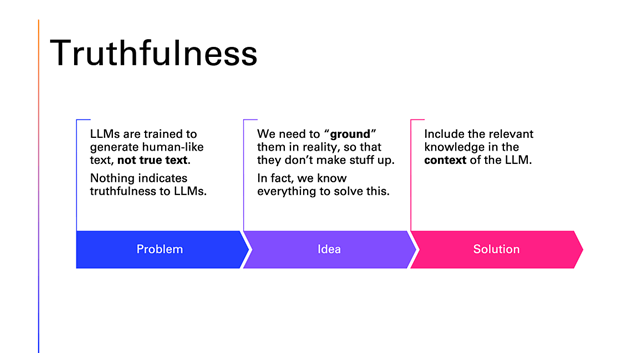 LLMs suffer from hallucinations, but this can be mitigated
by providing additional context.
You might have heard about the term “hallucination” in the context
of LLMs, which refers to the phenomenon of LLMs making up facts when
they shouldn’t.
Why does that happen? Well, the LLM learns only to generate text,
not factually true text. Nothing in its training gives the model
any indicator of the truth or reliability of any of the training data.
However, that is not even the main issue here, it’s that generally
text out there on the internet and in books sounds confident, so the
LLM of course learns to sound that way, too, even if it is wrong.
In this way, an LLM has little indication of uncertainty.
That being said, this is an active area of research, from which we
can expect that LLMs will be less prone to hallucinations over time.
For example, during instruction tuning we can try and teach the LLM
to abstain from hallucinating to some extent, but only time will tell
whether we can fully solve this issue.
You may be surprised that we can actually try to solve this problem
here together right now. We have the knowledge we need to figure out
a solution that at least partially helps and is already used widely
today.
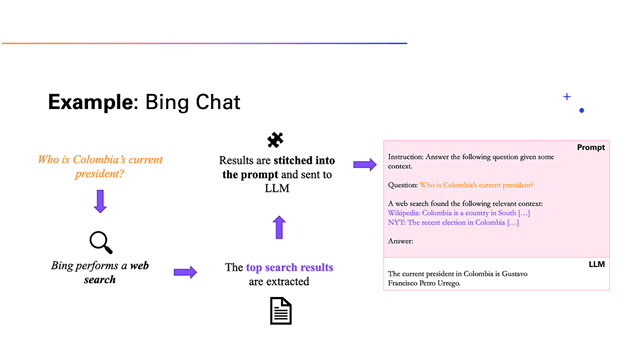 Bing chat is an example of a search-based LLM workflow.
Suppose that you ask the LLM the following question: Who is the current president of Colombia? There’s a good chance an LLM may respond with the wrong name. This could be because of two reasons:
- The first is what we have already brought up: The LLM may just hallucinate and simply respond with a wrong or even fake name.
- The second one I will mention only in passing: LLMs are trained only on data up to a certain cut-off date, and that can be as early as last year. Because of that, the LLM cannot even know the current president with certainty, because things could have changed since the data was created.
So how can we solve both these problems? The answer lies in providing
the model some relevant context.
The rationale here is that everything that’s in the LLM’s input
sequence is readily available for it to process, while any implicit
knowledge it has acquired in pre-training is more difficult and
precarious for it to retrieve.
Suppose we were to include the Wikipedia article on Colombia’s
political history as context for the LLM. In that case it would much
more likely to answer correctly because it can simply extract the
name from the context (given that it is up to date and includes the
current president of course).
In the image above you can see what a typical prompt for an LLM with
additional context may look like.
By the way, prompt is just another name for the instructions we give
to an LLM, i.e., the instructions form the input sequence.
This process is called grounding the LLM in the context, or in the
real world if you like, rather than allowing it to generate freely.
And that’s exactly how Bing Chat and other search-based LLMs work.
They first extract relevant context from the web using a search engine
and then pass all that information to the LLM, alongside the user’s
initial question.